
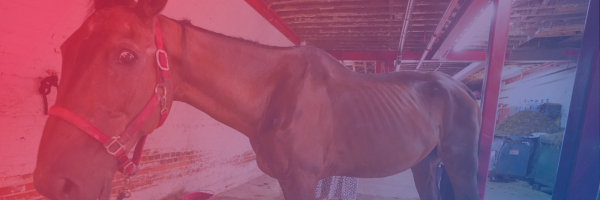
Picture this: a thousand-pound animal who should enjoy open pasture, but is wearing blinders, hitched to a carriage full of tourists — navigating the intersection of Sixth Avenue and Central Park South during rush hour.
Buses accelerating. Horns blaring. Exhaust rising off the asphalt.
That is not a romanticized past. That is a Tuesday afternoon in New York City and it is killing horses.
New York City carriage horses have been at the center of an escalating crisis for years. In fact, recent events have made one thing undeniable: this industry cannot be regulated into safety. It needs to end.
Below is what has happened, what legislation exists to stop it, and what you can do right now.
A Pattern of Death and Danger
Devastatingly, 18-year-old Romanch Mahajan lost his life after a horse became spooked and collided with another carriage in Central Park on June 17, 2026. We extend our deepest condolences to his family, whose lives have been forever changed by this unimaginable loss.
On June 9, 2026, a 16-year-old carriage horse named Deniz collapsed and died near West 72nd Street while pulling passengers through Central Park. His death was not an isolated incident — it was the latest in a string of serious events stretching more than a year, with no sign of stopping.
Recent Incidents at a Glance
🐴 June 17, 2026 — Teenager dies after being flung from carriage: Romanch Mahajan, an 18-year-old tourist from India, died after a horse named Sampson spooked and bolted away from his driver.
🐴 June 9, 2026 — Deniz dies in Central Park: A 16-year-old horse collapses and dies while pulling tourists through the park. Advocates and elected officials call for immediate action.
🐴 May 2026 — Carriage overturned during heat advisory: Two horses named Otis and Troy were reportedly working during a heat advisory when one became spooked, crashed into the other, and overturned a carriage, sending a driver to the hospital.
🐴 January 8, 2026 — Runaway horse strikes five cars: A horse named Destiny bolted through the intersection of Sixth Avenue and West 59th Street, hitting four to five vehicles and tearing the bumper off a taxicab.
🐴 September 2025 — Tourists forced to jump from moving carriage: With passengers still on board, a spooked horse bolted and forced two tourists to leap out while the animal careened across the park and destroyed a metal sign.
🐴 August 2025 — Lady dies in Midtown: A horse named Lady collapsed and died on 11th Avenue while pulling a carriage through Midtown Manhattan.
🐴 August 2022 — Ryder collapses on 9th Avenue: An elderly horse named Ryder collapsed in the summer heat, and veterinarians euthanized him two months later. His name now lives on in the legislation before the City Council.
Moreover, in the thirteen months leading up to Deniz’s death, at least seven separate serious incidents involved Central Park carriage horses. These are not freak accidents — they are the foreseeable result of an industry operating in conditions horses were never built to withstand. As a result, the Central Park Conservancy — which manages the park and holds no advocacy mission — formally concluded that the industry poses a genuine public safety risk and called on lawmakers to end it.
Why Carriage Horses Don’t Belong on NYC Streets
To understand why this keeps happening, you need to understand one basic thing about horses: they are prey animals.
Their survival instincts center on detecting threats and fleeing from them. Consequently, the sounds, smells, and sudden movements of Midtown Manhattan — backfiring engines, sirens, cyclists cutting through traffic — can override years of training in a fraction of a second.
The Physical Toll Is Relentless
Beyond the flight risk, the daily conditions of carriage work cause serious cumulative harm:
- Hard pavement puts constant stress on joints and hooves
- Diesel exhaust from one of the city’s most congested corridors fills their lungs for hours at a time
- Extreme heat radiating off asphalt creates physiological dangers that open fields simply do not
- No ability to signal distress — carriage horses cannot slow down or stop without a human choosing to notice
- No daily turnout — when not working, carriage horses return to three-storied buildings as stables, and have no access to pasture which is vital for their metal and physical well-being
The industry’s defenders often say carriage horses are “just strolling in the park.” Yet Deniz, Lady, and Ryder were not strolling. All three died doing this work.
Romanch’s Law: The Path Forward for Horses and Workers
Named for the horse whose 2022 collapse became a turning point, Romanch’s Law, formerly known as Ryder’s Law, is the legislation before the New York City Council that would phase out the horse-drawn carriage industry entirely.
Council Member Christopher Marte reintroduced the bill on June 11, 2026 — just two days after Deniz’s death. Specifically, it would:
- Wind down the issuance of new industry licenses
- Transition the industry out over a defined period
- Ensure horses find humane new homes rather than face slaughter or transfer to other carriage operations
A Just Transition for Carriage Workers, Too
Voters For Animal Rights recognizes that the carriage drivers represented by TWU Local 100 are workers who deserve a fair future — not just a pink slip. Ending carriage rides in NYC should not mean abandoning the people whose livelihoods depend on the industry today. VFAR wants to work with the TWU to find a transition path that protects workers with real job alternatives, retraining support, and wages that reflect the value of their labor.
When former Mayor Adams proposed a transition plan as part of his executive order supporting Ryder’s Law (now known as Romanch’s Law), city officials cited the potential for drivers to earn more than $70,000 annually under a restructured city employment model — significantly more than the industry average of under $40,000 per year. In other words, a just transition is possible. Workers and horses do not have to be pitted against each other.
The Support Is There
- Two-thirds of NYC voters favor ending horse-drawn carriages
- Mayor Zohran Mamdani supports the bill’s passage
- The Central Park Conservancy has formally called for a ban
- 21 co-sponsors have signed on since the bill’s reintroduction (As of July 10, 2026)
- NYC Council Speaker Julie Menin and Health Committe Chair Lynn Schulman has called for a hearing on Romanch’s Law, formerly known as Ryder’s Law, Intro 943, to take place on July 15, 2026.
New York City Has Done This Before
New York is not a city that struggles to change when the evidence demands it.
Smoking bans in bars and restaurants were once politically contentious — until they weren’t. New York also banned trans fats in restaurant food, removed single-use plastic bags citywide, and ended countless other practices once considered simply part of life here, once the harm became impossible to ignore. In each case, the city chose to move forward.
Horse-drawn carriage rides in NYC are no different. This is not a cultural treasure worth protecting — it is a commercial tourism operation that routinely injures and kills the animals at its center. Furthermore, cities including Chicago, Key West, and Biloxi have already made this change. New York, which prides itself on leading, is lagging behind.
The City Council has the power to change that. They need to hear that New Yorkers want them to.
Sign the Petition: Pass Romanch’s Law Now
Deniz died on June 9, 2026. His death was not inevitable — it was the predictable result of an industry the City Council has the authority to end, and has so far declined to act on.
Romanch’s Law, formerly known as Ryder’s Law, is before the Council today. The mayor supports it, and so does an overwhelming majority of New Yorkers. What the bill needs now is enough Council votes to pass.
Add your name. Tell the NYC City Council: pass Romanch’s Law, formerly known as Ryder’s Law. End carriage rides in New York City. No more horses should die on our streets.