
Extreme Confinement of Farmed Animals: The Hidden Cages New York Must End
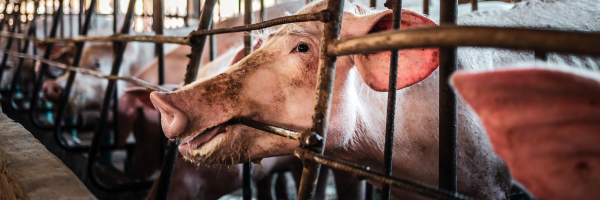
When most people picture a farm, they imagine open fields and red barns. The reality for millions of farmed animals in the United States looks nothing like that. Instead, it looks like a cage.
Producers confine pigs, calves, and hens to spaces so small the animals can barely move for months, sometimes years, at a time. This is extreme confinement, and it is not a fringe practice. It is standard industry procedure, happening right now, to animals raised for products sold here in New York.
At Voters For Animal Rights, we believe animal protection is a matter of political power, not charity. That means changing the laws that allow this suffering to continue — and that starts with understanding exactly what extreme confinement looks like.
What Is Extreme Confinement of Farmed Animals?
Gestation crates confine mother pigs during pregnancy in metal enclosures roughly 2 feet wide — barely larger than their own bodies. These mothers cannot turn around or walk freely. Many spend nearly their entire reproductive lives standing or lying in the same few square feet, cycle after cycle.
Veal crates confine baby calves, many taken from their mothers within a day of birth, in stalls that prevent normal movement and social contact. Producers keep these calves this way for the entirety of their short lives before slaughter.
Battery cages pack egg-laying hens into wire enclosures, often giving each bird less space than a standard sheet of paper. These hens cannot spread their wings or nest. Most live their entire lives standing on wire mesh.
These systems exist for one reason: they are cheap for producers. Animal welfare isn’t part of the design. Instead, every inch is engineered to maximize output in minimum space.
Ending Extreme Confinement of Farmed Animals Is a Policy Fight
Confinement practices like these persist because the law allows them to. Some states have already acted, banning gestation crates, veal crates, and battery cages outright or phasing them out over time. Public opinion is not ambiguous here — most people, when shown what these systems actually look like, want them gone.
That gap between what the public wants and what the law allows is where electoral and legislative advocacy makes the difference. Bans don’t happen because an industry decides to change. They happen because voters demand it, candidates respond to that demand, and voters hold legislators accountable for following through.
This is the work Voters For Animal Rights exists to do: organizing political pressure so that animal protection isn’t an afterthought in New York’s policy conversations — it’s a priority lawmakers have to answer to.
The Federal Threat: The Save Our Bacon Act
Just as some states have made progress banning extreme confinement, a federal bill is working to undo that progress. The Save Our Bacon Act would prevent states from enforcing their own confinement laws. That holds true for any pork, eggs, or veal sold within their borders, as long as the animals were raised in other states.
This bill takes direct aim at two existing victories: California’s Proposition 12 and Massachusetts’ Question 3. Voters approved both measures by large margins at the ballot box. Both ban the in-state sale of pork, eggs, and veal raised in gestation crates, battery cages, and veal crates. Both laws have already survived legal challenges, including at the U.S. Supreme Court. Having lost in court, the bill’s backers are now trying to win in Congress instead.
New York doesn’t yet have its own statewide confinement ban, but the threat is still close to home. The Save Our Bacon Act would foreclose New York’s ability to ever enact one. It would also undercut the same legal reasoning that let New York City’s foie gras ban survive its own court fight. The bill has already passed the House as part of the 2026 Farm Bill and is now before the Senate Agriculture Committee.
New York’s senators, Chuck Schumer and Kirsten Gillibrand, have both publicly opposed the Save Our Bacon Act, and the Senate Agriculture Committee’s June 2026 version of the Farm Bill leaves it out. That’s a real win, and it’s worth celebrating. But this isn’t the first time this language has surfaced in Congress, and it likely won’t be the last: it could still be added back through an amendment, and similar provisions have returned again and again under different names in prior sessions. The fight to keep it out has to continue for as long as the Farm Bill is being negotiated, and beyond.
Help End Extreme Confinement of Farmed Animals
Ending extreme confinement requires sustained pressure on lawmakers to close loopholes, ban these practices outright, and enforce the bans already on the books. That pressure starts with public demand they can’t ignore.
Sign our petition to call on lawmakers to end the extreme confinement of farmed animals — including gestation crates, veal crates, and battery cages — for good.
Every signature adds to the public record showing legislators that voters are watching — and that animal protection is a political priority, not a footnote.
👉 Sign the petition now to demand an end to extreme confinement.
The animals locked in these cages can’t advocate for themselves in the halls of government. But voters can. That’s exactly the work Voters For Animal Rights does — and we need you with us.