
What Is the Save Our Bacon Act? The Facts Voters Need to Know
If you’ve heard the term “Save Our Bacon Act” and aren’t sure what it actually does, you’re not alone. The name sounds harmless, however the reality is anything but. The Save Our Bacon Act is a piece of federal legislation that would strip states of their power to set basic animal welfare standards for the meat, eggs, and dairy sold within their borders — and it’s currently moving through Congress.
Here’s what the Save Our Bacon Act is, where it came from, what it would actually do, and why animal advocates across the country are working to stop it.
What Is the Save Our Bacon Act, Exactly?
The Save Our Bacon Act is H.R. 4673, introduced in the U.S. House of Representatives by Iowa Congresswoman Ashley Hinson. A companion bill in the Senate, S. 1326 (the Food Security and Farm Protection Act), carries nearly identical language and was introduced by Iowa Senator Joni Ernst.
The core purpose of the Save Our Bacon Act is to bar state and local governments from regulating how farmed animals raised in other states are housed and produced, as long as the resulting meat, eggs, or dairy cross state lines for sale. In plain terms: if a state’s voters or legislature decide they don’t want extreme-confinement pork, eggs, or veal sold in their state, the Save Our Bacon Act would override that decision.
Where Did the Save Our Bacon Act Come From?
The Save Our Bacon Act isn’t a new idea — it’s the latest version of a years-long push by the pork industry to undo state-level animal welfare wins. Its direct predecessor was the Ending Agricultural Trade Suppression (EATS) Act, which failed to advance in the House in 2025. Before that, similar language was known as the King Amendment.
The driving force behind the Save Our Bacon Act has been the National Pork Producers Council, an industry group whose membership includes some of the largest pork companies in the world, including Smithfield Foods. After the EATS Act stalled, the same policy reappeared under the friendlier-sounding “Save Our Bacon” name and was also introduced in the Senate as the Food Security and Farm Protection Act.
What State Laws Would the Save Our Bacon Act Undo?
The Save Our Bacon Act is a direct response to two voter-approved state laws:
- California’s Proposition 12 — Approved by more than 7.5 million California voters in 2018, Prop 12 bans the in-state sale of pork, eggs, and veal from animals raised in extreme confinement: gestation crates for breeding pigs, battery cages for laying hens, and veal crates for calves.
- Massachusetts’ Question 3 — Approved by more than 2.5 million Massachusetts voters in 2016, Question 3 prohibits the same categories of extreme confinement for pork, eggs, and veal sold in that state.
Both laws have already survived legal challenges. The U.S. Supreme Court upheld Prop 12 against a pork-industry lawsuit, and in October 2025 the First Circuit Court of Appeals affirmed that Question 3 is constitutional. Having lost in court, opponents of these laws turned to Congress — and the Save Our Bacon Act is the result.
What About New York?
New York doesn’t yet have a Prop 12-style ban on its books, but the Save Our Bacon Act would still hit close to home — both because of a New York City law already fighting this exact battle, and because of state legislation New York keeps trying to pass.
New York City’s foie gras ban. In 2019, the City Council passed Local Law 202, prohibiting the sale of foie gras made by force-feeding ducks and geese, after a campaign led by Voters For Animal Rights and more than 50 coalition partners. The law has been tied up in court for years after upstate producers and the state Department of Agriculture and Markets argued it improperly restricted farms outside the city. In March 2026, the Appellate Division ruled the city can enforce the ban, affirming that a local government can restrict the in-state sale of a product made through a practice it considers inhumane — the same basic legal principle Prop 12 and Question 3 rely on, and the same principle the Save Our Bacon Act is designed to undercut at the federal level.
New York State’s unfinished business on confinement. Unlike California and Massachusetts, New York has not yet enacted a statewide ban on battery cages, gestation crates, or veal crates. Versions of a cage-free egg bill have been introduced repeatedly in the State Senate, most recently as S950, and a broader bill phasing out gestation crates, veal crates, and battery cages together has likewise been reintroduced session after session without passing. The New York City Bar Association’s Animal Law Committee has formally supported the cage-free legislation, calling the confinement of egg-laying hens inhumane.
That unfinished history matters here: if the Save Our Bacon Act becomes federal law, it would foreclose the door New York is currently trying to walk through. Any future New York law modeled on Prop 12 or Question 3 — cage-free eggs, crate-free pork, crate-free veal — could be preempted before it ever takes effect, regardless of how state lawmakers or voters feel about it.
What Would the Save Our Bacon Act Mean for Animals?
If enacted, the Save Our Bacon Act would reopen the door to some of the cruelest confinement practices in industrial animal agriculture:
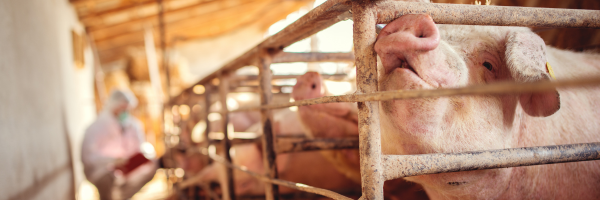
- Gestation crates confine breeding pigs in spaces so small the animals cannot turn around for nearly their entire pregnancies.
- Battery cages pack egg-laying hens so tightly they can barely move, let alone spread their wings.
- Veal crates restrain newborn calves to limit muscle development, keeping their flesh “tender.”
These are not fringe concerns — research cited in news coverage of the Save Our Bacon Act notes that pigs confined in gestation crates often chew on the metal bars out of frustration, sometimes until their mouths bleed. The whole point of Prop 12 and Question 3 was to phase out exactly these practices. The Save Our Bacon Act would erase that progress and let companies resume them, as long as the products are sold in a state without a similar ban.
It’s Not Just About Pigs — and Not Just About California
A legislative analysis from Harvard Law School’s Brooks McCormick Jr. Animal Law & Policy Program found that the Save Our Bacon Act’s reach extends well beyond Proposition 12. The report concluded the bill could jeopardize hundreds of state and local laws and regulations governing farmed animal production — including rules aimed at controlling animal disease outbreaks and protecting public health, not just animal welfare. The same analysis warned the bill would likely generate significant legal uncertainty, inviting lawsuits over which state rules can still be enforced.
In other words, the Save Our Bacon Act’s name suggests a narrow, single-issue fix. The actual bill text is far broader, with consequences that could reach farmers, food safety regulators, and consumers in every state — not only the ones with confinement bans on the books.
Where Does the Save Our Bacon Act Stand Right Now?
The Save Our Bacon Act has moved further than any of its predecessor bills:
- February 2026: House Agriculture Committee Chairman Glenn “GT” Thompson introduced the 2026 Farm Bill (H.R. 7567) with the Save Our Bacon Act’s language built in as Section 12006.
- April 30, 2026: The full House of Representatives passed the Farm Bill, including the Save Our Bacon Act provision, by a vote of 224–200. A bipartisan amendment to strip the language out was blocked from getting a floor vote.
- Now: The Farm Bill, with the Save Our Bacon Act still attached, is in the hands of the Senate Agriculture Committee. A coalition of family farmers, ranchers, and independent meat companies has organized to push the committee to drop the provision before it reaches the Senate floor, where it would need 60 votes to pass.
Who Supports and Who Opposes the Save Our Bacon Act?
Supporters of the Save Our Bacon Act include the National Pork Producers Council, the Iowa Pork Producers Association, the Iowa Farm Bureau, and Iowa’s governor and attorney general. Their argument is that state-by-state confinement rules create a costly “patchwork” for producers who ship products across state lines.
Opponents form a notably broad coalition — more than 6,600 groups and individuals, including not just animal protection organizations but also independent farmers, ranchers, veterinarians, food safety advocates, and elected officials from both parties. Many of these farmers point out that they’ve already invested in crate-free systems to meet consumer demand and would be put at a competitive disadvantage if larger operations could undercut them by returning to cheaper, crueler confinement methods.
Why the Save Our Bacon Act Matters to Voters
More than 80% of voters support modest farmed animal welfare standards like the ones in Prop 12 and Question 3. Both laws passed by wide margins at the ballot box. The Save Our Bacon Act would let Congress override the will of millions of voters in two states — and set a precedent that could be used against future ballot measures anywhere in the country.
For an organization like Voters For Animal Rights, the through-line is simple: animal protection laws that voters fought for and won shouldn’t be quietly erased through a federal farm bill rider with a folksy name. The Save Our Bacon Act isn’t really about “saving bacon.” It’s about whether voters get to decide how the animals raised for food in their state are treated or whether that decision gets made for them in Washington.
What You Can Do
The Save Our Bacon Act is currently in the Senate’s hands as part of the 2026 Farm Bill. Contacting your U.S. senators — regardless of party or committee assignment — and asking them to remove the Save Our Bacon Act language from the Farm Bill is the most direct way to weigh in while the bill is still being negotiated. For New Yorkers, that means reaching out to Senators Chuck Schumer and Kirsten Gillibrand directly, on top of any other advocacy you’re already doing for state and city animal protection laws.