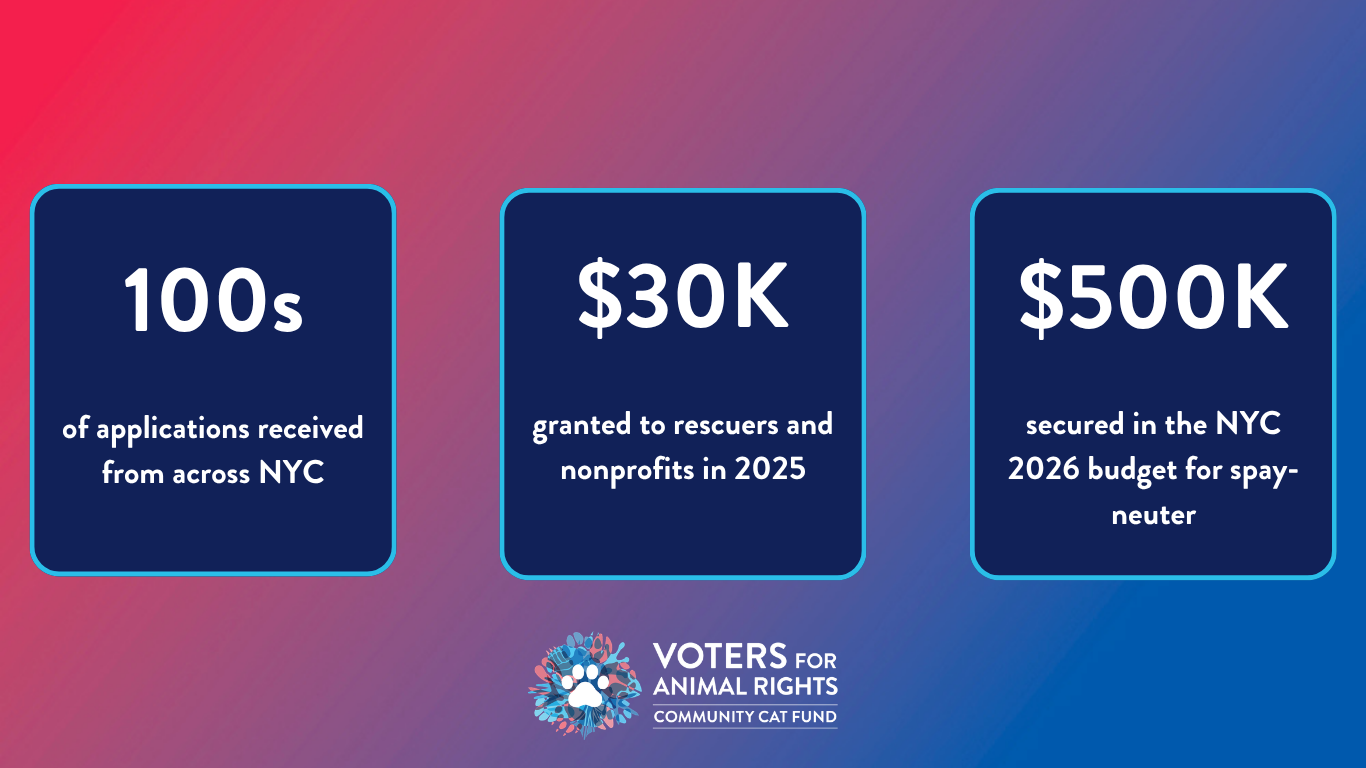
It started with a hearing. In the fall of 2024, Voters For Animal Rights (VFAR) organized what would become a defining moment for animal rights in New York City: a City Council hearing on the state of animal rescue and the crisis of community cats. We did all of it. The organizing, the outreach, the preparation of testifiers, the coordination of advocates from every corner of the five boroughs. What followed was eight hours of testimony, more than 500 pieces of written testimony submitted, and over 300 people in attendance. It was the largest showing of community cat advocates the City Council had ever seen.
Critically, the hearing produced something we had long sought: the ASPCA, for the first time, publicly admitted that more funding is needed for spay-neuter programs in New York City. That acknowledgment — from the city’s most prominent animal protection institution — changed the terms of the conversation. Suddenly, the question was no longer whether the need was real. The question became: what would the City do about it?
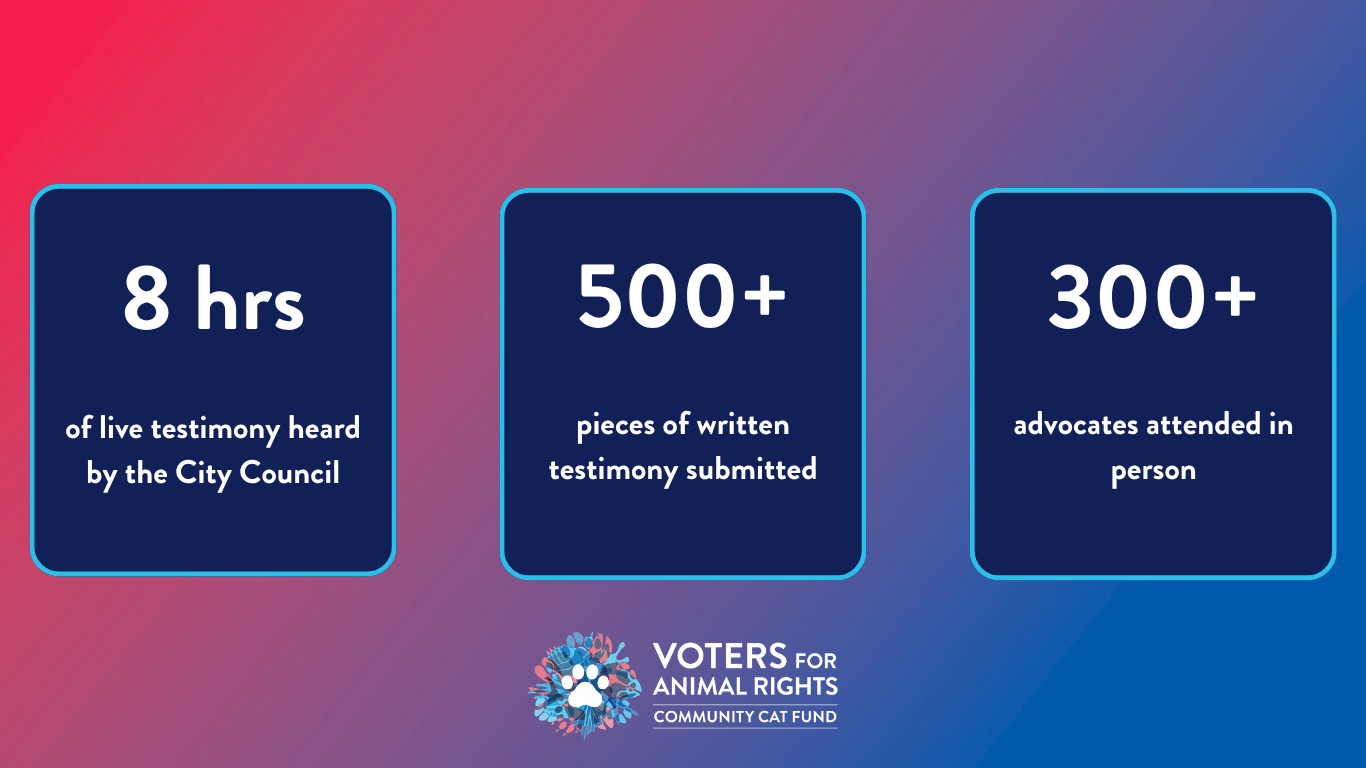
When we launched the VFAR Community Cat Fund earlier this year, we didn’t know quite what to expect. We knew the need was there. What we didn’t anticipate, however, was the flood — hundreds of applications from individual rescuers working out of their own pockets, from small nonprofits stretched thin, from trap-neuter-return volunteers who have spent years doing this work without a safety net. Their stories didn’t just move us. Remarkably, they moved City Hall.
This is the story of how a grassroots grant program became the evidence base for the largest single investment in spay-neuter in New York City history.
The hearing
Eight hours. 500 testimonies. One turning point.
The fall 2024 City Council hearing on animal rescue was not an accident — it was the result of months of organizing by VFAR. We recruited and prepared every testifier. We coordinated the advocates. We made sure that the voices filling that hearing room reflected the full geography and diversity of New York City’s community cat crisis. The numbers speak for themselves:
The fund
We asked. New York answered.
The VFAR Community Cat Fund was designed to do two things: provide direct, immediate relief to the people on the front lines of community cat care, and generate real documentation of the scale and nature of unmet need across the five boroughs. Above all, we wanted to put money in the hands of the people doing the work — and we wanted to hear their stories.
What came back was overwhelming. For instance, we heard from rescuers managing dozens of outdoor cats on fixed incomes, TNR volunteers who had been self-funding surgeries for years, and small nonprofits rationing spay-neuter slots because the waitlists were too long and the funding too scarce. In addition, many community members had been doing this work quietly, without recognition or support, simply because the cats in their neighborhoods needed someone.
As a result, we granted $30,000 across individual rescuers and nonprofit organizations — for spay-neuter surgeries, for traps and supplies, for the unglamorous infrastructure that keeps cats from reproducing into crisis. Every dollar went directly to the animals and the humans who care for them.
The stories
What the applications revealed
Numbers tell part of the story. Even so, the applications themselves told the rest. Across hundreds of submissions, several themes emerged again and again:
Self-funding is the norm, not the exception. The majority of applicants were individuals spending hundreds — sometimes thousands — of dollars of their own money each year on cats in their buildings, blocks, and neighborhoods. No reimbursement exists. No support structure backs them up. Yet still, they show up — because the work needs doing.
Waitlists are long and growing. Multiple nonprofit applicants described spay-neuter waitlists stretching weeks or months. Meanwhile, cats reproduce. As a consequence, the need compounds — and what could be managed humanely with adequate resources becomes a neighborhood crisis without them.
Community care is collective care. Many applicants described neighbors, building staff, and local business owners contributing to cat colonies together — informal networks of care that have no institutional support but represent exactly the kind of community investment the city should be amplifying.
Spay-neuter works — when it’s accessible. Applicants who had successfully completed TNR on their colonies described dramatic changes: fewer complaints from neighbors, healthier cats, more stable populations. The intervention is proven. The gap is access and funding.
The outcome
How $30,000 helped unlock $500,000
This is where the story gets good. Because the Community Cat Fund wasn’t just a grant program — it was, above all, a listening exercise. And what we heard, we brought directly to City Hall.
Crucially, the applications gave us something invaluable: real, documented, named proof of need from across the five boroughs. Not anecdotes. Not estimates. Rather, these were actual stories from actual New Yorkers, on the record, describing exactly what adequate spay-neuter funding would mean for the cats and communities they care for.
We took those stories to our allies on the City Council and put them in front of budget negotiators. Together, we made the case — backed by data, backed by voices, backed by the sheer volume of applications we received — that this was not a niche ask. In fact, this was a citywide need with citywide demand.
We also made a straightforward argument to the Council: if a small organization like VFAR could raise and grant $30,000 to community cat rescuers, a city operating with a $100 billion budget could certainly chip in. The math was undeniable. The moral case was airtight. And we weren’t going to let anyone in that room forget it.
A special note of gratitude is owed to Council Members Justin Brannan and Lynn Schulman, whose championship of this issue helped make it possible for the City Council budget to allocate a grant to Flatbush Cats — one of Brooklyn’s most dedicated community cat organizations — and whose sustained advocacy inside City Hall helped turn grassroots pressure into budget reality.
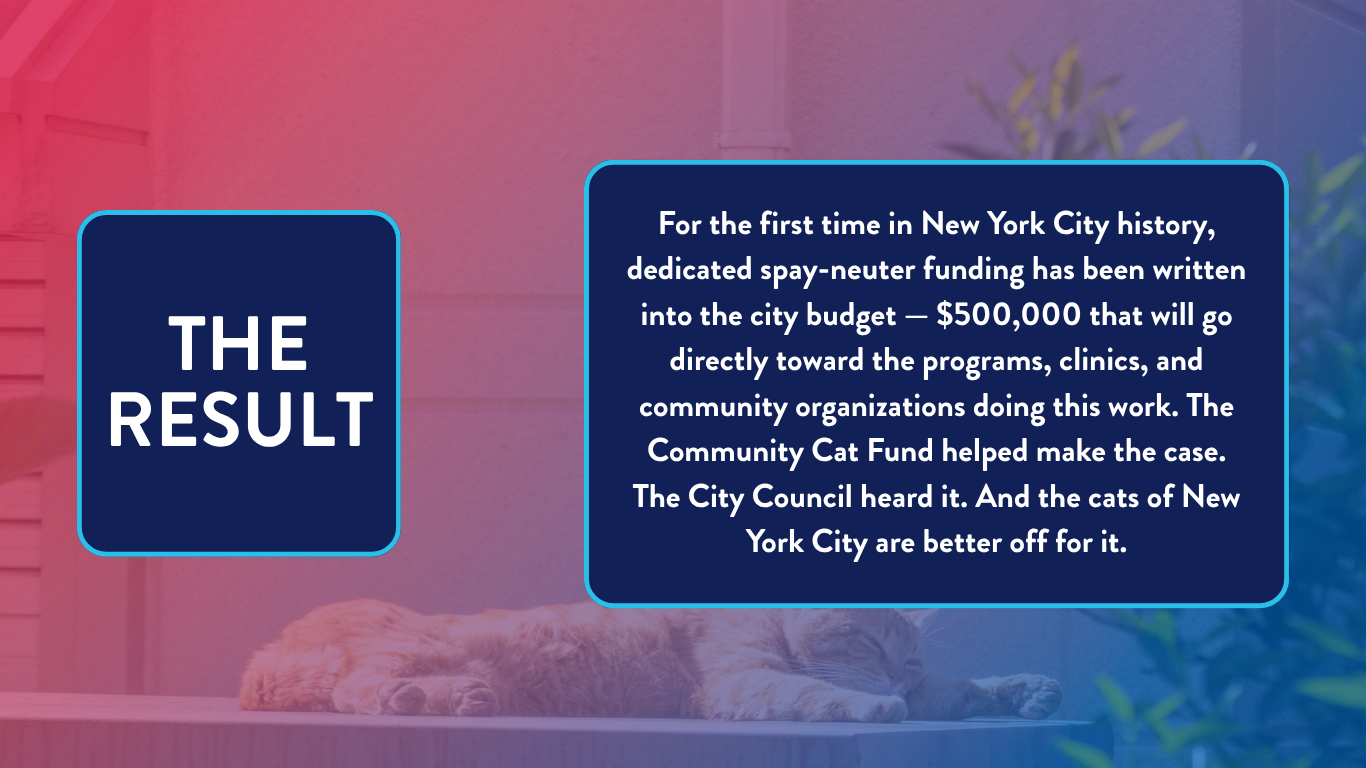
Ultimately, this is what the VFAR model looks like in practice. We don’t just advocate in the abstract. Instead, we build evidence, center the stories of the people doing the work, and use that foundation to move institutions. The Community Cat Fund was a $30,000 investment that helped generate a $500,000 return for animals across the city. And this is only the beginning.
What’s next
$500,000 is a start. We’re pushing for more.
We are proud of what we won in the 2026 budget. At the same time, we are clear-eyed about what it means: a beginning, not an endpoint. The applications we received made plain that the need across New York City vastly outpaces what $500,000 can address. Hundreds of rescuers are still self-funding. Waitlists remain long. Moreover, cats are still reproducing in neighborhoods where TNR resources are scarce.
Therefore, our goal is to make spay-neuter funding a permanent, growing line in the New York City budget — increasing year over year until it matches the scale of need. That means returning to City Hall in 2026 to fight for more in the 2027 budget. It also means continuing to document stories, build coalitions, and make the case for every dollar. Ultimately, it means having the resources to keep doing this work at the level it deserves.
Support the work
Help us win $500K again — and then some.
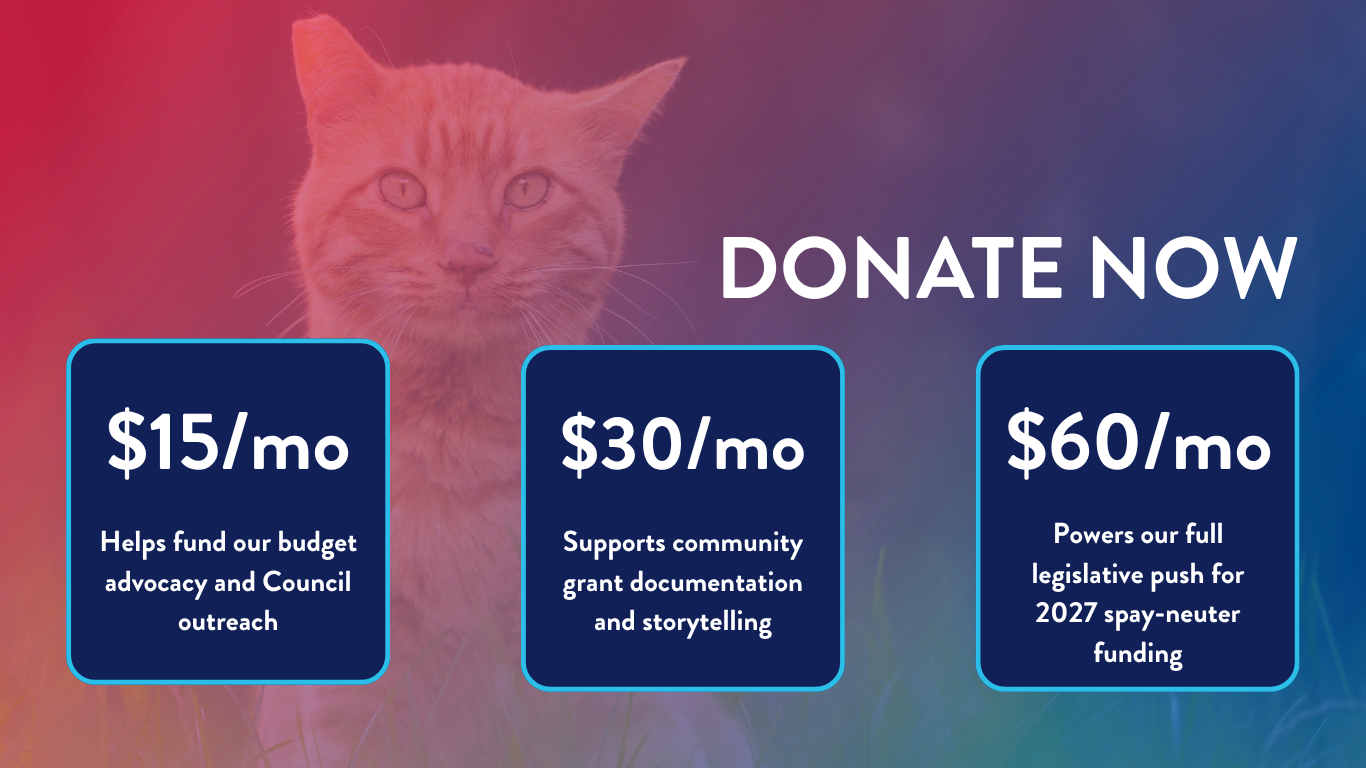
The cats of New York City can’t afford for us to stop now. Your donation funds the advocacy, the community organizing, and the budget fights that turn grassroots stories into city policy. Every dollar you give is a step toward permanent, funded, citywide spay-neuter access.