When we talk about animal protection, we’re talking about real lives. The duck in a foie gras operation who is communicating pain and fear through every behavior available to her. The New York City pigeon dying slowly on a glue strip, struggling with everything he has. The dog in an overcrowded shelter, whose stress signals go unread for months. Animals are telling us what they need and for too long, the systems around them have refused to listen. At Voters for Animal Rights, we are committed to changing those systems. And over the past two years, we’ve moved the needle in ways we’re proud to share with you.
At VFAR, we believe that elections have consequences for animals. That’s not just a slogan — it’s our operating principle. We use civic power: lobbying, legislation, electoral advocacy, and coalition-building to turn the political landscape into one where animals are recognized as the sentient beings they are, with interests that matter and voices that deserve to be heard. And right now? That strategy is working.
But before we look at what’s ahead, let’s celebrate one result that shows exactly what’s possible when good law meets real commitment. In 2023, VFAR championed a ban on guinea pig sales in New York City pet stores alongside Deputy Speaker Council Member Diana Ayala — and the data since then speaks for itself.
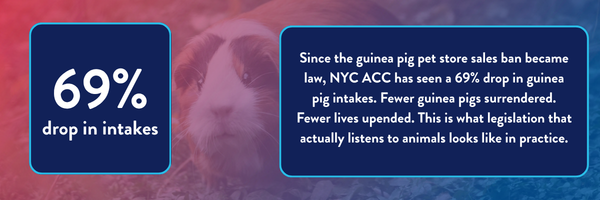
This is proof of concept and it’s why we keep pushing for more. Good policy transforms lives. It is the most scalable form of animal protection we have.
In the courts
We Won — and We’re Not Backing Down
The fight to uphold New York City’s foie gras ban has been long, expensive, and fiercely contested and we are winning it. Our latest appellate division victory is a landmark moment, reinforcing the legal foundation of one of the most significant farm animal protections enacted anywhere in the United States. Foie gras production involves force-feeding ducks and geese against every instinct they possess. The science on their suffering is unambiguous. The law is on our side.
But the fight isn’t over. Governor Hochul has appealed our victory, choosing to side with the foie gras industry over the ducks and geese who suffer in it. We are disappointed and we are undeterred. We will keep fighting in court, in Albany, and in the public square until this ban is fully in effect and the animals it protects are finally free from this cruelty.
In Albany
Protecting New York at the State Level
This legislative session, we’ve been busy in Albany — introducing bills, building relationships with lawmakers, and making our presence felt. Here’s what we’ve accomplished at the state level:
Glue trap legislation: We introduced a bill to prohibit glue traps in all state-owned and state-leased buildings. These devices cause prolonged, agonizing suffering to any animal who encounters them — and they have no place in government property.
Octopus farming ban: We introduced and advanced legislation to prevent industrial octopus farming from ever taking root in New York State. Octopuses are remarkably intelligent, curious animals — and we are getting ahead of a cruel industry before it arrives at our shores.
Pet store bird sales ban: We introduced new legislation to prohibit the sale of birds in pet stores, addressing a pipeline that strips birds of their freedom and often funds inhumane breeding operations.
Lobby Day success: We organized a successful lobby day in Albany, bringing advocates face-to-face with lawmakers to put animal protection front and center on the legislative agenda.
In New York City
Our Deepest Roots, Our Biggest Wins
New York City is where we can have such an impact that it ripples worldwide, and the past two years have been among our most productive in City Hall. From historic funding wins to groundbreaking new legislation, here is what we have fought for and achieved on behalf of the animals of this city:
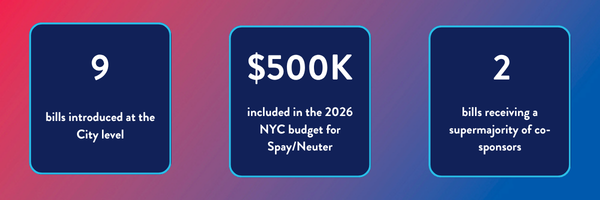
$500,000 for spay-neuter: For the first time in history, we achieved adding half a million dollars in dedicated city funding for spay-neuter programs — a watershed moment for reducing animal homelessness and the suffering that comes with it.
Backyard breeder bill passed: After sustained advocacy, we led the passage of legislation targeting backyard breeders — a critical step in cracking down on unregulated operations that prioritize profit over the wellbeing of the animals in their care.
Glue trap ban introduced: Building on our state effort, we introduced parallel legislation at the city level to prohibit glue traps — pushing for humane rodent management across all city properties.
Animal Welfare Caucus launched: We helped launch a formal Animal Welfare Caucus within the City Council — creating a permanent institutional home for animal protection priorities, year after year.
First-ever animal rescue hearing: We organized the first City Council hearing on the state of animal rescue in New York City where hundreds of animals spoke up to lawmakers — shining a light on the challenges facing shelters, rescues, and the animals living within them.
Rodeo bill advanced to supermajority: Legislation to restrict cruel rodeo practices in New York City advanced to supermajority support in the Council — a remarkable demonstration of political momentum for the animals who suffer in these events. (We are working on getting it re-introduced this session.)
Pet food pantry bill advanced to supermajority: A bill to establish city-funded pet food pantries — helping low-income New Yorkers keep their animal companions fed and their families intact — also reached supermajority support. (We are working on getting it re-introduced this session.)
Sick leave for pet care introduced: We introduced new legislation that would allow workers to use sick leave for veterinary appointments — recognizing that animal companions are family, and that their health is a legitimate human need. (We are working to get a supermajority on this legislation.)
Pet store bird sales ban introduced: Mirroring our state effort, we introduced city-level legislation to end the sale of birds in pet stores — closing a key chapter in the commercial exploitation of animals whose natural lives deserve to be lived freely. (We are working on getting it re-introduced this session.)
None of this happened by accident. It happened because VFAR has built genuine political power — the kind that comes from years of showing up, earning trust, and making animals a priority that elected officials take seriously. We are not a protest organization. We are a political force. And we are growing.
But the work ahead is harder than the work behind us. Bills need to cross the finish line. Courts need to hear more cases. The Animal Welfare Caucus needs resources and allies. And animals — in factory farms, in shelters, in laboratories, on our streets — are counting on us to keep going. We owe it to them to show up with everything we have.