
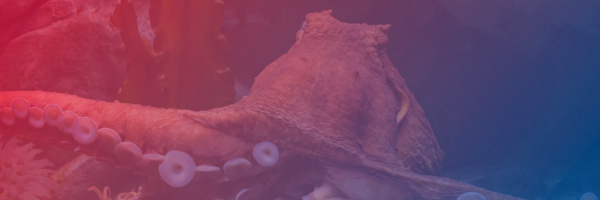
Let’s be direct: industrial octopus farming is one of the most ethically indefensible industries being proposed right now.
We’re talking about confining highly intelligent, solitary animals — animals with three hearts, nine brains, and a nervous system scientists are still racing to understand — in bare tanks under constant artificial light, then killing them by forcing them into ice water until they die slowly.
Spain’s seafood giant Nueva Pescanova has plans to breed over one million octopuses a year this way. New York has a chance to make sure octopus farming never gets a foothold here. We have to take it.
Who Is the Octopus?
Before we get into the legislation, let’s make sure we’re all on the same page about who we’re protecting. Octopuses are not background beings. They are not simple. The science on this is unambiguous and it keeps getting stronger.
— An octopus has approximately 500 million neurons — comparable to a dog — distributed across the central brain and each of the eight arms.
— Each arm contains around 40 million neurons in local ganglia that act independently, processing sensory information and executing movement without waiting for a signal from the central brain.
— Each of the roughly 800 suckers on an octopus’s body functions simultaneously as nose, lips, and tongue — chemically analyzing everything they touch.
— A 2025 study in Scientific Reports documented 12 distinct arm movement types and 15 coordinated behaviors across nearly 7,000 observations of wild octopuses.
— The 2012 Cambridge Declaration on Consciousness formally recognized cephalopods as animals capable of conscious experience — the first time invertebrates received that recognition from a scientific consensus.
— A January 2026 paper in Biological Reviews updated and reaffirmed that case, drawing on extensive neuroanatomical, neurochemical, and behavioral evidence.
Octopuses use tools, solve novel problems, recognize individual human faces, and engage in what researchers call play behavior. They are escape artists — not because they’re afraid, but because they’re curious. Captivity causes them documented psychological and neurological harm, including self-injury, aggression, and mass die-offs. The science is not on the side of octopus farming.
“Octopus farming is incompatible with any meaningful standard of animal welfare. These animals have complex cognitive and emotional lives that simply cannot be accommodated in a commercial farming environment.”
— Julie Cappiello, President, Voters for Animal Rights
Why Industrial Octopus Farming Is an Environmental Disaster
The animal welfare case against octopus farming is already conclusive, but the environmental case is just as damning and it hits close to home for New York.
— Global octopus catch surpassed 500,000 tons in 2021, up from just 36,700 tons in 1950. Demand is not slowing down.
— Octopus farming requires roughly three times an octopus’s body weight in wild-caught fish to produce each farmed octopus. It does not reduce pressure on wild fish populations — it dramatically increases it.
— New York has seen an 81% surge in harmful algal blooms between 2020 and 2024. Intensive carnivore aquaculture, with its nitrogen- and phosphorus-loaded effluent, makes this significantly worse.
NYU researchers published the definitive case against octopus farming in Issues in Science and Technology in 2019, concluding it would produce high levels of pollution, risk spreading antibiotic-resistant bacteria, threaten wild populations through escapes, and harm the artisanal fishing communities that depend on healthy oceans.
In August 2024, more than 100 scientists published a letter in the journal Science calling on Congress to pass the OCTOPUS Act, stating flatly that high-welfare commercial octopus farming is currently impossible.
The NYC Bar Association’s Animal Law Committee reviewed the evidence and concluded that octopus farming “threatens animal welfare, marine ecosystems, public health, and local fisheries, with no clear benefit.”
The Legislation: New York Can Act Before It’s Too Late
Bill S.7421-A / A.8043-A, sponsored by Senator Monica Martinez and Assembly Member Tony Simone, would ban industrial octopus farming in New York State. It would make it illegal to factory farm any octopus species for human consumption and prohibit the sale or possession of any octopus from commercial octopus farms. Civil penalties run up to $1,000 per day per offense, enforced by the DEC. Wild-caught octopuses and research uses are unaffected.
In May 2026, the Assembly bill cleared committee — a real milestone. Washington State and California have already banned industrial octopus farming. Oregon, Connecticut, Hawai’i, New Jersey, North Carolina, and Massachusetts are all working on their own bans. New York has the chance to be the first state on the East Coast to pass one.
If you’ve followed VFAR’s work on foie gras, you know why the timing is everything. We have been in court for years fighting two farms. Two. Now picture what it looks like to challenge an entrenched octopus farming industry with dozens of operations, thousands of jobs, and deep lobbying connections. We do not want to find out. The window to stop industrial octopus farming in New York is open right now and we have to use it.
“The moment to stop octopus farming is before it starts. Once this industry gets its hooks in — and it will try — the fight becomes exponentially harder. New York voters have the power to prevent that.”
— Julie Cappiello, President, Voters for Animal Rights
What You Can Do Right Now
Two actions. Both take under two minutes.
New York State: Contact your state Senator and Assembly Member and ask them to support S.7421-A / A.8043-A. VFAR has made it simple at vfar.org/octopus.
Federal: Urge Congress to pass the OCTOPUS Act and shut the door nationwide. Take action here.