
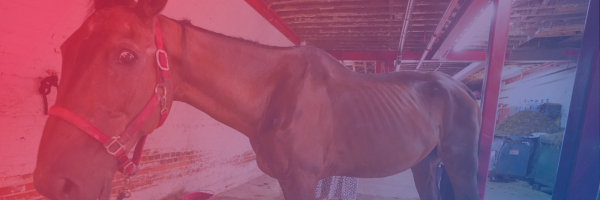
On a sweltering NYC August evening in 2022, a carriage horse named Ryder collapsed on the pavement at the intersection of West 45th Street and 9th Avenue in Hell’s Kitchen. Bystanders watched in horror as he rolled onto his side, unable to rise, while police officers poured water over his overheated body. Viral video captured what happened next: his driver snapping the reins at him, demanding he get up.
View this post on Instagram
Ryder died that October. A necropsy later revealed he had cancer. He was 26 years old — the equivalent, advocates say, of a 90-year-old human being — and he had been working the streets of Manhattan in the August heat.
This is the reality of horse carriages in NYC. And it is why New Yorkers — and the elected officials who serve them — must finish what Ryder’s story started.
Ryder Was Not an Exception. He Was the Rule.
The industry’s defenders would have you believe that Ryder was an isolated incident, an anomaly in an otherwise well-regulated trade. The record says otherwise.
In August 2025 — three years after Ryder’s collapse and just days before a renewed push to pass reform legislation — a 15-year-old carriage horse named Lady collapsed and died at West 51st Street and 11th Avenue. Workers and the NYPD were filmed dragging her body into a trailer as witnesses looked on in disbelief. And in that same month, a horse named Bambi bolted through Central Park with no driver at the reins, sending three carriage passengers leaping from the speeding buggy to safety.
Three incidents. One month. One industry.
“No animal should suffer like this, especially not on our city streets in the middle of traffic and chaos,” said Allie Taylor of Voters For Animal Rights after Lady’s death. “How many more horses must collapse or die before the City Council takes action? This cruelty is not tradition — it’s abuse.”
The pattern of harm surrounding horse carriages in NYC is not a series of accidents. It is the predictable outcome of forcing large, sensitive prey animals to work in one of the most chaotic urban environments on earth.
What Ryder’s Story Revealed About the Industry
The collapse of Ryder did not just break hearts. It exposed the systemic failures that allow horses to be worked into the ground with minimal accountability.
Paperwork listed Ryder’s age as 13. He was actually 26. He had been working as a carriage horse for only four months before he collapsed, arriving in the city in April, passing a mandatory physical exam, and then rapidly losing weight over the summer as his health deteriorated. He should have been pulled from work and examined by an equine veterinarian. He was not.
His driver, Ian McKeever, was eventually charged with a misdemeanor count of overdriving and injuring an animal. The case went to trial in July 2025. McKeever was acquitted. The jury heard his attorney argue that Ryder had simply tripped and fallen. Witnesses described a horse showing visible signs of distress for hours before he went down.
Justice was not served for Ryder. That is exactly why legislation matters.
Ryder’s Law: So Close, and Yet
In response to Ryder’s death, Voters For Animal Rights and allied advocates pushed the New York City Council to pass Ryder’s Law (Intro. 967), legislation that would phase out horse carriages in NYC. The bill had the backing of a wide coalition: animal protection organizations, elected officials, celebrity supporters including Joaquin Phoenix, Billie Eilish, and Rooney Mara, and — eventually — Mayor Eric Adams himself, who reversed his long-standing opposition to a ban in September 2025 and called on the Council to act.
Polling showed overwhelming public support. One survey found 78% of New York City voters in favor of ending the industry. Another found 71% support specifically for a ban.
And yet, on November 14, 2025, the New York City Council’s Committee on Health voted Ryder’s Law down — 4 to 1, with two abstentions — before it could ever reach a full Council vote. The bill died in committee, its lead sponsor, Council Member Robert Holden, term-limited out of office at the end of the year.
Horse carriages in NYC are still operating. The fight is not over, but it is clear that the Council, as currently constituted, will not act without sustained, relentless pressure from voters.
How You Can Help Carriage Horses
The defeat of Ryder’s Law is a setback, but not the end. Mayor Zohran Mamdani, who took office January 1, 2026, has voiced support for ending the industry. The new Council will need to introduce fresh legislation and start the process again. The question isn’t if New York will ban horse-drawn carriages. It’s when and that depends entirely on whether enough New Yorkers make their voices heard.
The single most important thing you can do right now is sign our petition to ban horse carriages in NYC.
The horses working the streets of Manhattan right now cannot call their council member. They cannot vote. They cannot demand better.
You can.
Here’s what else you can do:
Vote with animals in mind. Check the VFAR Animal Rights Voter Guide before every election. Support candidates who take strong positions on animal welfare and hold accountable those who don’t.
Support Voters For Animal Rights. Sustained advocacy requires sustained resources. Your donation funds lobbying, voter outreach, and the long work of turning public sentiment into law. Donate today.