
10 Mind-Blowing Octopus Facts (And Why New York Just Made History for These Incredible Animals)
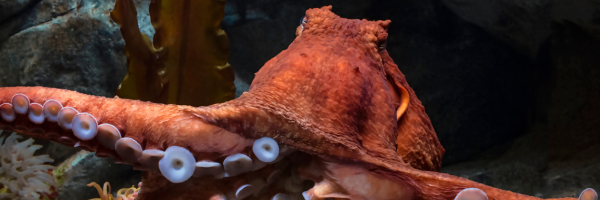
Ask most people to name the smartest animal on the planet, and you’ll get the usual answers: chimpanzees, dolphins, maybe an African grey parrot. Almost nobody says octopus. And yet, the more scientists study these eight-armed cephalopods, the clearer it becomes: octopuses are some of the most intelligent, complex, and surprising animals alive today.
That’s why New York State lawmakers just took a historic stand to protect them. Below, we’re breaking down ten facts about octopuses that prove just how remarkable they are, and what it means that New York is now on the verge of banning industrial octopus farming for good.
1. Octopuses Have Three Hearts
Two of an octopus’s hearts pump blood to its gills, while the third pumps blood to the rest of their body. Interestingly, that main heart actually stops beating when the octopus swims, which is one reason octopuses prefer crawling along the seafloor to swimming. It’s simply more efficient for their unusual cardiovascular system.
2. Their Blood Is Blue
Octopus blood gets their color from a copper-based protein called hemocyanin, rather than the iron-based hemoglobin that makes human blood red. Hemocyanin is more efficient at transporting oxygen in cold, low-oxygen environments, which helps octopuses thrive in deep, chilly ocean waters.
3. Octopuses Are Escape Artists
Octopuses have no bones, which means they can squeeze their entire body through any opening larger than their eyeball. Aquariums have documented octopuses unscrewing jar lids, prying open tank lids, and slipping through tiny gaps to make a break for freedom. One New Zealand aquarium octopus famously escaped his tank, traveled across the floor, and slid down a drainpipe back into the ocean.
4. They Solve Puzzles and Use Tools
Octopuses have been observed unscrewing jars from the inside to retrieve food, navigating mazes, and even carrying coconut shells or shell fragments to use as portable shelters, a textbook example of tool use once thought unique to a handful of mammals and birds.
5. Every Arm Has a Mind of Its Own
About two-thirds of an octopus’s neurons live not in their brain, but in their arms. Each arm can taste, touch, and react somewhat independently, allowing an octopus to explore a crevice with one arm while solving a problem with another.
6. They Recognize Individual Humans
Researchers and aquarium staff have reported octopuses appearing to distinguish between individual people, behaving differently toward caretakers they’re familiar with than toward strangers. Some have even been observed squirting water at people they seem to dislike.
7. Octopuses Display Distinct Personalities
Scientific studies have found measurable differences in boldness, curiosity, and reactivity among individual octopuses, the building blocks of personality. Some are bold explorers, others are cautious and reserved, just like individuals across many other intelligent species.
8. They Can Change Color and Texture in an Instant
Using specialized skin cells called chromatophores, octopuses can shift color and even mimic the texture of rocks, coral, or sand in a fraction of a second, making them masters of camouflage and, in some species, surprisingly expressive communicators.
9. Octopuses Are Formally Recognized as Sentient Beings
In 2021, the United Kingdom passed the Animal Welfare (Sentience) Act, formally recognizing octopuses, alongside other cephalopods, as sentient beings deserving of legal protection. In 2024, the New York Declaration on Animal Consciousness affirmed the same scientific consensus: octopuses are conscious animals capable of experience.
10. New York Just Voted to Ban Octopus Farming
This is the fact we’re most excited to share. In early June 2026, the New York State Legislature passed bipartisan legislation (S.7421B/A.8043C) to prohibit industrial octopus farming in New York State. The Assembly passed it 129-13, and the Senate passed it 55-5. New York is poised to become the first state on the East Coast, joining Washington and California, to make sure octopus farms never operate within its borders.
That bill is now sitting in front of Governor Hochul, awaiting her signature. We have until the end of 2026 to make sure she signs it.
Read the full story of how this bill passed →
Why This Bill Matters
Octopuses are wild, solitary, highly intelligent animals. Confining them to crowded industrial tanks isn’t just incompatible with their nature, it’s a recipe for suffering on a massive scale. Octopus farming also threatens marine ecosystems already under pressure, requiring enormous quantities of wild-caught fish as feed and risking disease spread to wild octopus populations.
There are no octopus farms operating in New York today. This legislation makes sure it stays that way, permanently.
But a bill passing the legislature isn’t the finish line. Governor Hochul still needs to sign it into law, and getting a governor’s signature takes sustained public pressure: emails, calls, media coverage, and a team ready to act the moment action is needed.
This Is the Work VFAR Does, Every Single Day
Voters For Animal Rights is an all-volunteer, scrappy little organization that punches way above its weight in Albany and City Hall, and we only get to do that because of people like you. We don’t have a big-budget PR department. We have advocates who show up, again and again, for the animals who can’t show up for themselves.
Right now, we’re in the final stretch of getting this octopus bill signed. We’re also fighting on a dozen other fronts, from carriage horse protections to glue trap bans to spay/neuter funding, and we need a sustainable base of support to keep showing up for all of it.
That’s why we built the Animal Voter Collective, our monthly giving program for people who want to power this work for the long haul, not just one campaign at a time.
Become a Monthly Donor Today
A monthly gift, even a small one, means we can respond the moment Governor Hochul calls this bill to her desk, mobilize an action alert, and keep pressure on until she signs. It means we can keep doing this work consistently, instead of campaign to campaign, scrambling for resources.
Join the Animal Voter Collective →
Octopuses can’t vote, call their senator, or sign a petition. But you can, and your monthly support makes sure VFAR can keep showing up for them and every other animal whose fate is decided in Albany and City Hall.