Farmed Animals
New York Dairy Workers and Cows Pay the Price as the Dairy Industry Pushes for Cheaper Labor
The dairy industry runs on two kinds of bodies it can control: cows it keeps pregnant and milks around the clock, and workers who have little power to say no. Right now, the industry is lobbying Washington to make that second group even easier to control. New York, one of the country’s biggest dairy states, is right in the middle of it.
A new investigation from Sentient Media shows how dairy and other factory farming operations want to bring in workers on temporary H-2A visas. The Trump administration supports the push. Meanwhile, a new federal wage formula drives pay for those workers down. For anyone who cares about animals, this matters. An industry that profits from squeezing cows also profits from squeezing people. The same political fight decides how far it can go with both.
How the Trump administration and the dairy industry want to control workers
H-2A visas let farms bring in workers from other countries for temporary or seasonal jobs. The government issued more than 315,000 in 2024, and H-2A workers now make up about one in six U.S. farmworkers. But the law only covers seasonal work, and cows need milking every day of the year. So most dairy farms can’t use it.
The industry wants that changed, and it has allies at the top. Agriculture Secretary Brooke Rollins has called expanding H-2A into dairy her top priority. A June 2026 DHS memo said dairy “can involve” eligible temporary or seasonal labor, which immigration experts read as a signal of leniency. In Congress, Rep. Glenn Thompson’s Securing Agriculture’s Workforce Act would let the Agriculture Secretary define what counts as farm labor. That could even include meat processing and slaughter jobs.
A wage rule that drives pay down
At the same time, the administration is pushing pay down. In October 2025, the Department of Labor changed how it sets the minimum H-2A wage. The Labor Department projects that 92% of H-2A workers will land in its lowest “skill level I” tier. That tier pays around the 17th percentile of local farm wages. Employers can also deduct housing costs from paychecks.
Sentient Media‘s analysis found the gaps are huge:
- In Georgia, the H-2A baseline for dairy work is about 67% below the state average, or $39,892 less per year.
- In almost a third of states, the gap is more than $30,000 a year.
- In New York, a dairy worker named Jiménez earns $19.20 an hour while working nearly 80 hours a week. The skill level I rate for H-2A workers here would be $13.62.
A federal judge ruled the method unlawful in August 2026 and gave the Labor Department until December 30 to replace it. Employers still pay workers under it in the meantime. Farms must pay workers doing the same job at least the H-2A rate. So a lower H-2A wage can drag down pay for everyone, citizens included.
Tied to one employer
H-2A visas tie workers to a single employer. That employer often controls where they sleep, how they get to the store, and whether they can stay in the country. Leaving a bad boss can mean losing your visa. Advocates warn that this hands employers enormous power over people far from home. It also raises the risk of trafficking and abuse.
Control from Washington, threats from the boss
This is the trap the Trump administration is building. On one side, it wants a visa program that gives employers near-total control over the people they hire. On the other, its mass deportation campaign hands managers a weapon against workers already here. That weapon is the threat of a call to ICE.
Sadly, that threat is common across factory farming. California dairy worker José Arias sued over unpaid overtime. In response, the dairy’s attorney contacted ICE to try to have immigration agents deport him. In 2021, a nitrogen leak killed six workers at a Georgia poultry plant. Company representatives reportedly questioned survivors about immigration status before letting them get medical care. One worker said managers know many workers are undocumented and use it to silence them.
The pattern runs through meatpacking too. High Country News and the Food & Environment Reporting Network reviewed nearly a hundred lawsuits, complaints, and investigations into the industry. In 2026, workers at the JBS beef plant in Colorado voted to strike. Organizers said the fear of retaliation was very real.
Here in New York, that fear follows dairy workers everywhere. One worker told Spectrum News that people on the farms always fear someone will call immigration. Even local police and sheriffs feel like a threat.
These are people who get up before dawn to care for animals. They work through injuries and holidays, and they keep New York’s dairy industry running. If speaking up means risking deportation, they can’t report injuries, stolen wages, or abuse of the cows in their care. That silence is exactly what factory farming depends on.
The New York dairy industry by the numbers
New York is the fifth-largest dairy state in the country, and its dairy industry is worth $3.9 billion. Dairy brings in half of state agricultural income, from nearly 2,800 dairy farms.
In 2025, New York farms held 642,000 cows used for milk and produced more than 16.5 billion pounds of milk. The state supplies over 7% of U.S. milk.
The industry is consolidating fast. In agricultural trade publications, federal census data shows about 1,900 New York dairy farms shuttered over a five-year period. The farms that remain keep getting bigger. One Ontario County operation holds 6,000 dairy cows and milks them three times a day.
Bigger farms need more hired hands, and migrants make up roughly half the workforce. The work is dangerous: between 2006 and 2016, 69 farmworkers died in New York’s dairy industry.
What New York dairy workers say about their working conditions
Milked is a report by the Workers’ Center of Central New York and the Worker Justice Center of New York. Its authors interviewed 88 immigrant dairy workers on 53 farms across the state. Its findings showed how much the industry depends on people with very little power:
- Two-thirds had been hurt on the job at least once.
- Workers usually put in about 12 hours a day, six days a week. One in ten had no day off at all.
- Average pay was about $9.32 an hour, and 28% had experienced wage theft.
- 97% lived in employer housing. Among those with complaints, 58% reported bug infestations and 48% had no locks on their doors.
- Many rarely left the farm, going about 11 days between trips off the property.
A hard-won law, then a new wave of fear
New York’s 2019 farmworker labor law was a real step forward. It gave farmworkers minimum wage, overtime, sick leave, a weekly day off, and the right to unionize. The farmworker minimum wage is now $16 an hour.
But Documented NY reported in June 2026 that fear is again shaping daily life on New York dairies. Immigration enforcement has detained dozens of people in the state since January 2025. One worker, Lazaro, described working about 70 hours a week at one farm and sharing housing with 18 people. Another worker said he went two straight years without a day off, working up to 85 hours a week. Workers say organizing has stalled because people are afraid.
Workers are asking for protection
Dairy workers, many without legal status, have asked the New York Farm Bureau to back the New York for All Act. The bill would protect New Yorkers without permanent legal status, including farm and food workers, from immigration enforcement. They also asked the Farm Bureau to oppose expanding H-2A into dairy. Their reasoning is simple: dairy work is year-round, H-2A covers only seasonal jobs, and the program opens the door to abuse.
The cows at the center of industrial dairy farming
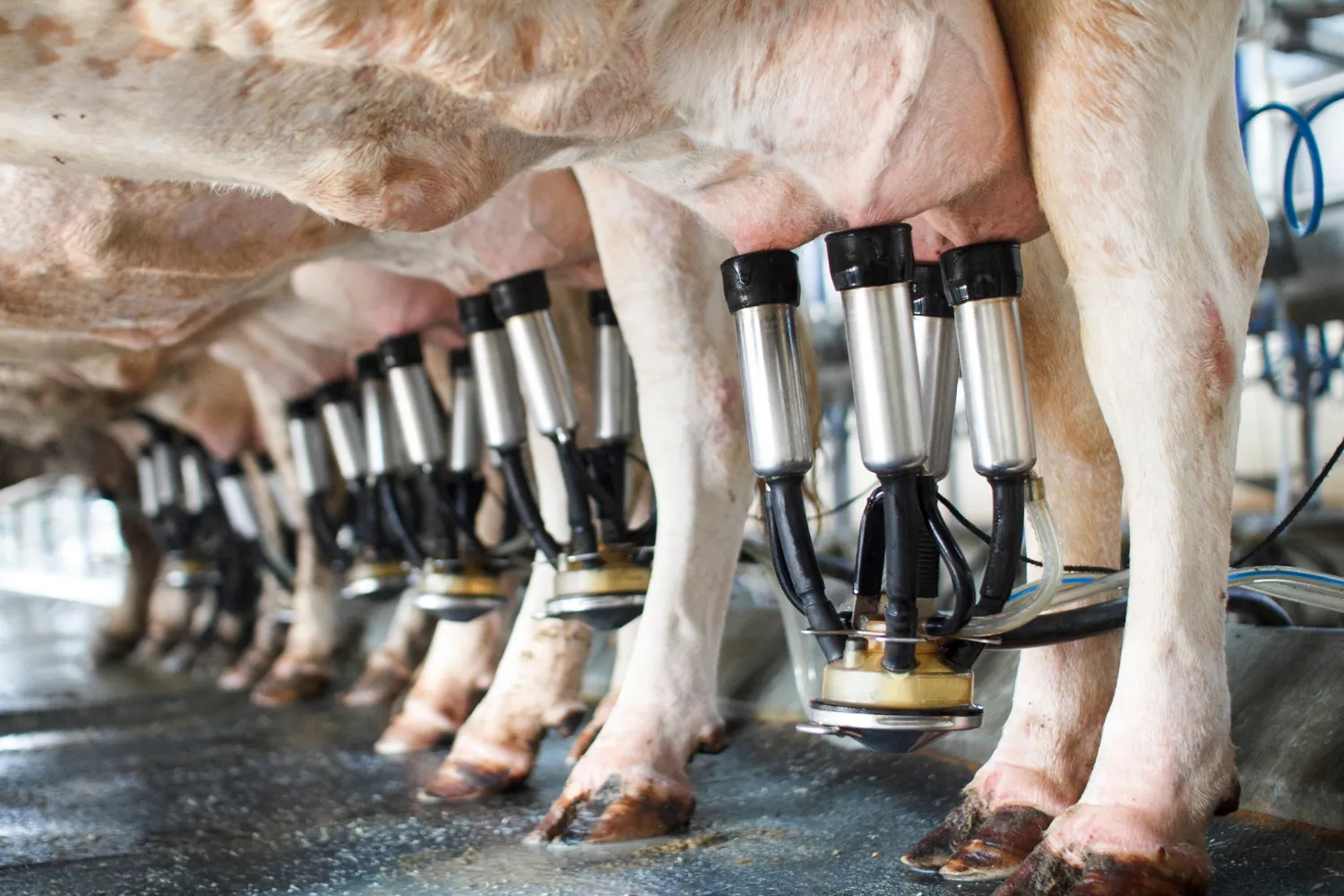
The reason dairy needs workers year-round is the same reason dairy is so hard on cows. The industry forces every one of New York’s 642,000 dairy cows to give birth again and again so she keeps producing milk. Farms take her calves from her. They milk her multiple times a day, every day, until her production drops. Then they send her to slaughter.
Workers see this up close. In Milked, 71% of workers named cows and bulls as the biggest danger on the job. Cows can weigh 1,000 to 1,500 pounds, and workers described newly milked cows as especially unpredictable. That is what happens when exhausted people must handle frightened animals at high speed. A third of the workers surveyed had no job training at all. Many others got only brief training, often in a language they didn’t speak well or through pantomime.
One H-2A dairy job listing cited by Sentient Media even describes tasks involving “cold stressed cows.” A system that treats cows as production units will treat the people caring for them the same way. A cheaper, more controllable workforce means more pressure to move faster, cut corners, and look away. Cows pay for that too.
Protect animals, workers, and the environment: volunteer with Voters For Animal Rights
The dairy industry doesn’t win these fights because people agree with it. It wins because it shows up in Washington and Albany, year after year, with lobbyists and campaign money. Changing that takes political power, and political power takes people.
The same industrial farming system that confines cows and pushes workers to the edge also pollutes our water, air, and land. Lawmakers who protect one usually protect all three. Voters For Animal Rights works to elect them, hold them accountable, and pass laws that protect animals in New York and beyond.
We need volunteers to make calls, knock on doors, and show up at hearings. Help us elect candidates who stand up to factory farming. You don’t need any experience, just a few hours and a willingness to act.
Volunteer with Voters For Animal Rights and help us build the political power to protect animals, workers, and the environment.