
Farmed Animals
What Are Gestation Crates?
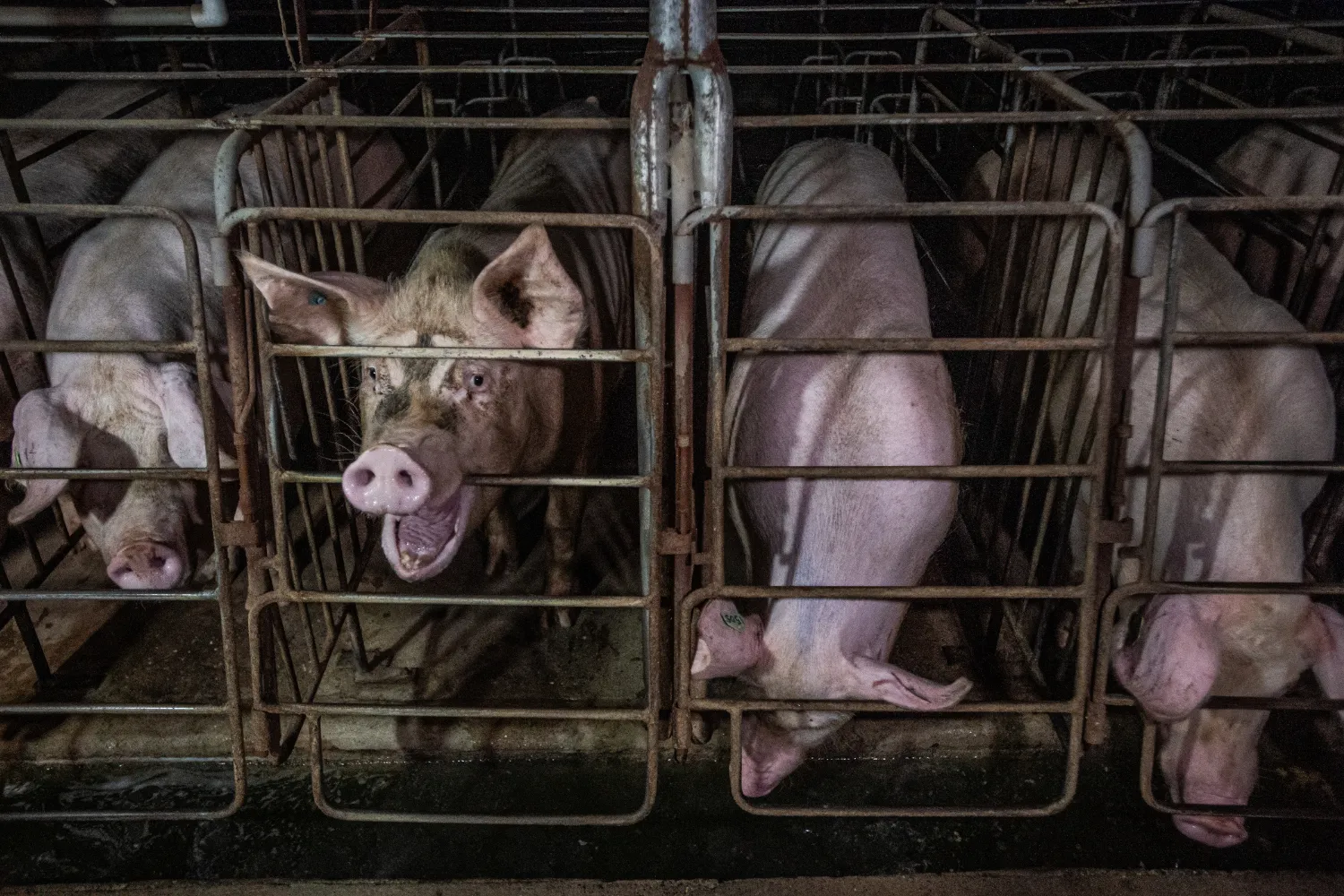
Gestation crates are metal cages that hold mother pigs for nearly their entire pregnancy, in a space so narrow she cannot turn around. They are still legal in most of the country.
Most people have never seen one. That’s by design. Gestation crates sit inside windowless industrial barns, far from the grocery aisle where the pork ends up. But they are one of the most common confinement systems in American agriculture, and they exist for one reason: the law allows them.
This post explains what gestation crates are, why veterinarians and scientists have documented their harm, which states have already prohibited them, and how the pork industry is trying to undo the laws that protect mother pigs.
What are gestation crates?
A gestation crate is an individual metal enclosure for a pregnant pig, called a sow. According to UC Davis, a typical gestation crate measures about 7 feet by 2 feet and gives each sow roughly 14 square feet of space. That is barely larger than her own body.
Sows are placed in the crate once they are bred. They stay there until about a week before giving birth, then are moved to a farrowing crate to nurse their piglets. A pig’s pregnancy lasts nearly four months, and sows on industrial farms are bred again and again. Many spend most of their lives in a cage.
Inside a gestation crate, a mother pig can:
- Stand up and lie down
- Take a step or two forward or back
She cannot:
- Turn around
- Walk, root or forage
- Build a nest before giving birth
- Lie next to or socialize with other pigs
The floors are usually slatted concrete or metal so waste falls into a pit below. Industry groups say the crates prevent sows from fighting over food, but gestation crates became widespread for a simpler reason: they let producers cram more animals into a single building.
Why gestation crates are cruel
Pigs are intelligent, curious and deeply social animals. A gestation crate takes every one of those traits and shuts it down.
The American Veterinary Medical Association notes in its review of sow housing research that crated sows can stand and lie down but cannot turn around, lie together or move to a more comfortable spot. USDA Agricultural Research Service scientists have likewise found that close confinement restricts a sow’s natural behavior.
The documented harms include:
- Weakened bones and muscles. Research comparing crated sows with group-housed sows found lower bone strength, less muscle mass and poorer cardiovascular health in sows who could not exercise.
- Injuries and infections. Sows develop sores from pressing against metal bars, along with overgrown hooves, lameness and urinary tract infections.
- Psychological distress. Unable to do almost anything, crated sows often bite the bars or chew at nothing for hours. Scientists call these stereotypic behaviors, and they are a recognized sign of chronic stress.
None of this is necessary. Group housing systems, already used by producers in states that prohibit gestation crates, give sows room to move and interact with each other.
Where gestation crates are prohibited
At least 11 states restrict or prohibit gestation crates. Most states still allow them, and there is no federal protection. Florida voters went first in 2002. Since then, states have acted through ballot measures, legislation and regulation, according to the USDA Economic Research Service and the ASPCA.
| State | How it passed | Year passed |
|---|---|---|
| New Jersey | Legislation | 2023 |
| California | Ballot measure (Prop 12, strengthening a 2008 measure) | 2018 |
| Massachusetts | Ballot measure (Question 3) | 2016 |
| Rhode Island | Legislation | 2012 |
| Ohio | Regulation, phase-out by 2026 | 2010 |
| Maine | Legislation | 2009 |
| Michigan | Legislation | 2009 |
| Colorado | Legislation | 2008 |
| Oregon | Legislation | 2007 |
| Arizona | Ballot measure | 2006 |
| Florida | Ballot measure | 2002 |
California and Massachusetts go further. Their laws also prohibit the sale of products from pigs born to mothers confined in gestation crates, no matter which state the farm is in. That is what makes them so powerful, and why the pork industry has spent years trying to overturn them. The U.S. Supreme Court upheld Prop 12 in 2023.
The federal threat to gestation crate laws: the Save Our Bacon Act
Every state law against gestation crates was won by voters and the legislators they elected. Those wins hold only as long as animal protection voters stay organized, because the pork industry is working to erase them.
While states move forward, the pork industry is trying to push every state backward. The so-called Save Our Bacon Act would stop states from applying their animal housing standards to products raised in other states, gutting laws like California’s Prop 12 and Massachusetts’ Question 3. A Harvard Law School analysis found it could jeopardize hundreds of state laws.
The House passed its Farm Bill with Save Our Bacon language on April 30, 2026. The Senate Agriculture Committee’s version leaves it out. As of November 27, 2026, the provision is one of the last issues blocking a final Farm Bill deal before the new Congress begins on January 3, per National Hog Farmer and Agri-Pulse. If it slips into the final bill, the protections voters won in states like California and Massachusetts could be undone.
Gestation crates FAQ
What is a gestation crate? A gestation crate is a metal cage, about 7 feet by 2 feet, used to confine a pregnant pig for most of her roughly four-month pregnancy. She can stand and lie down, but cannot turn around.
Why are gestation crates used? Producers say the crates prevent sows from fighting over food. In practice, they let industrial farms house more pigs in less space. Group housing systems prevent fighting without locking sows in cages.
How long are pigs kept in gestation crates? Sows are usually confined from breeding until about a week before giving birth. Because they are bred repeatedly, many spend most of their lives in crates.
Are gestation crates legal in the United States? Yes, in most states. No federal law prohibits them, and only about a dozen states restrict their use.
Which states prohibit gestation crates? At least 11: Arizona, California, Colorado, Florida, Maine, Massachusetts, Michigan, New Jersey, Ohio, Oregon and Rhode Island. California and Massachusetts also prohibit the sale of pork from crated sows.
What is the difference between a gestation crate and a farrowing crate? A gestation crate holds a sow during pregnancy. A farrowing crate holds her while she gives birth and nurses her piglets, and is just as restrictive.
Take action: sign the petition to end gestation crates
Gestation crates exist because the law allows them. Laws change when elected officials see that animal protection voters are organized and paying attention.
Add your name to our petition calling on Congress to end the extreme confinement of farmed animals, including gestation crates, veal crates and battery cages. Every signature tells lawmakers that voters want these cages gone, and that the Save Our Bacon Act has no place in the Farm Bill.
Sign the petition: Stop the Extreme Confinement of Farmed Animals →
Then share it with friends and family. The more voters who sign, the harder it is for Congress to look away.
Mother pigs have spent decades in cages too small to turn around in. Eleven states have already said that’s unacceptable. The rest of the country can be next.
Hero image: We Animals