Farmed Animals
What Is Foie Gras? Inside NYC’s Force-Feeding Ban
Foie gras is the enlarged, fatty liver of a duck or goose who has been force-fed until the organ swells far beyond its natural size. In 2019, Voters For Animal Rights (VFAR) led the campaign that got the New York City Council to prohibit its sale in restaurants and stores. Today, virtually all foie gras made in the United States comes from just two farms, both in Sullivan County, New York.
Here is what foie gras actually is, why Voters For Animal Rights fought to get it out of New York City, and where the fight stands now.
What is foie gras?
Foie gras means “fatty liver” in French. It is made by force-feeding ducks or geese, a process called gavage. In the U.S., the birds are almost always male Moulard ducks.
How is it made?
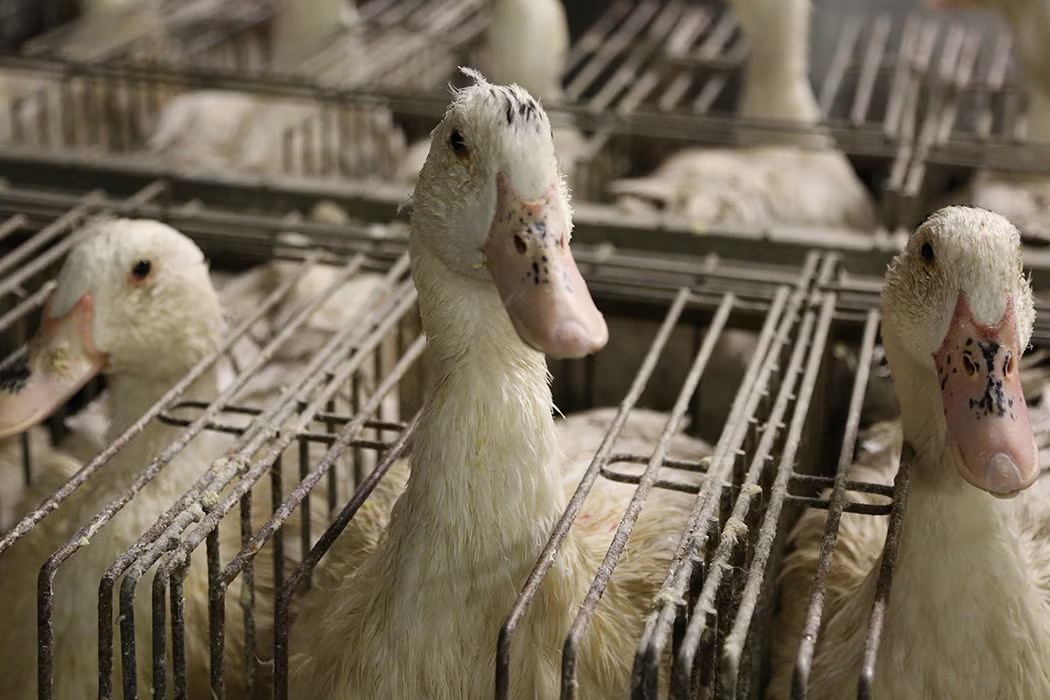
For the last few weeks of their lives, workers push a tube down each duck’s throat and pump in large amounts of corn-based feed, typically two or three times a day. A duck’s body cannot process that much food. The liver swells to roughly 10 times its normal size.
The result is a diseased organ. The force-feeding also causes:
- Injuries to the throat and esophagus from repeated tube insertion
- Labored breathing, as the swollen liver presses against the lungs
- Difficulty walking and standing
- Death before slaughter for some ducks
The New York City Bar Association told the City Council in 2019 that foie gras is made by force-feeding birds food they do not need, causing them pain, disease and often death. It also noted that no federal or New York State law specifically protects ducks and geese from force-feeding.
Is “humane” or “cage-free” foie gras different?
No. Some producers market their foie gras as cage-free or hand-fed, but foie gras, by definition, requires force-feeding a bird until the liver is diseased. Changing the housing does not change what happens to the duck’s body.
Why Voters For Animal Rights lobbied the NYC Council to prohibit force-feeding ducks and geese
Voters For Animal Rights led the campaign for Local Law 202 because New York City was one of the largest foie gras markets in the country, and cutting off that market was the most direct way to reduce the number of ducks force-fed in New York State.
The market was here
The two farms that make nearly all U.S. foie gras sit about two hours north of the city. Industry representatives told the New York Times that NYC accounted for about a third of their business, Patch reported. A Hudson Valley Foie Gras manager told Valley Table that the business had always been built on New York City.
That made the city the pressure point. A state ban on force-feeding alone would not stop sales; restaurants would simply switch suppliers, as the New York City Bar Association pointed out. A sales prohibition in the biggest market hits production directly.
Turning public opinion into political power
Voters For Animal Rights’ approach is electoral. We organize voters, endorse candidates who commit to protecting animals, and hold elected officials to those commitments. The foie gras campaign showed how that works:
- Council Member Carlina Rivera introduced Intro. 1378 in 2019.
- Voters For Animal Rights mobilized volunteers and supporters to call, email and meet with Council Members, and to testify at the June 2019 Health Committee hearing.
- The Council passed the bill overwhelmingly, and the city adopted it as Local Law 202 on November 25, 2019.
The law prohibits restaurants and retail food establishments in New York City from selling or serving foie gras and other products from force-fed birds.
The fight to enforce the law
The foie gras industry and New York State have spent years trying to stop the law from taking effect. The city has said it will not enforce the law until there is a final, nonappealable ruling, according to Bloomberg Law.
Voters For Animal Rights’ position is simple: New York City has the right to pass its own laws to protect animals. The Council voted, the courts upheld that vote, and Voters For Animal Rights will keep fighting until the law is enforced.
How many foie gras farms are in the United States?
Two farms produce virtually all foie gras made in the U.S.: Hudson Valley Foie Gras and La Belle Farm, both in Ferndale, Sullivan County, New York. The industry often describes itself as “three farms,” but the third is rarely named, and the two Sullivan County farms jointly told a court they make virtually all of the country’s foie gras.
| Farm | Location | Founded | Notes |
|---|---|---|---|
| Hudson Valley Foie Gras | Ferndale, NY | 1983 | The larger of the two; about 500,000 ducks slaughtered per year before the pandemic, per its manager in the Albany Times Union |
| La Belle Farm | Ferndale, NY | 1999 | Started by former Hudson Valley Foie Gras employees, per France-Amérique; says it raises over 182,000 ducks a year (Ground News) |
The two farms work in a cooperative business model. Together, they kill hundreds of thousands of ducks each year; advocates cited to amNY put the number at roughly 300,000.
What happened to the other U.S. foie gras farms?
California once had one producer, Sonoma Artisan Foie Gras. California’s law prohibiting force-feeding and the sale of force-fed products took effect in 2012, and the farm shut down, though the company continues as a distributor. That left New York as the center of the U.S. industry, which is exactly why New York’s laws matter so much for these ducks.
Where else is it prohibited?
California prohibits both force-feeding birds to enlarge their livers and selling products from force-fed birds; the U.S. Supreme Court declined to hear the industry’s challenges in 2019 and 2023. Outside the U.S., force-feeding ducks and geese is not permitted in the United Kingdom and in many European countries, though France, Hungary and a handful of others still produce it.
A federal prohibition: the Ducks and Geese Protection Act
On November 12, 2026, Rep. Veronica Escobar introduced H.R. 11014, the Ducks and Geese Protection Act. The bill would amend the Poultry Products Inspection Act to prohibit force-feeding ducks and geese nationwide. It has been referred to the House Agriculture Committee.
Voters For Animal Rights supports H.R. 11014. A federal prohibition would protect ducks no matter which state they are raised in, and it would close the door on the industry simply moving production elsewhere.
At the same time, the industry is pushing in the other direction. The so-called Save Our Bacon Act, which has been pushed for the Farm Bill, could wipe out state and local animal protection laws, including protections for ducks and geese from force-feeding. Voters For Animal Rights is fighting it.
FAQ
What is foie gras made of? Foie gras is the liver of a duck or goose who was force-fed until the liver became enlarged and fatty, often to about 10 times its normal size.
Is force-feeding ducks and geese cruel? Yes. Making foie gras requires force-feeding birds through a tube, which causes liver disease, throat injuries, breathing trouble and difficulty walking.
Is foie gras banned in New York City? NYC passed Local Law 202 in 2019, prohibiting the sale of foie gras in restaurants and stores. An appeals court upheld the law in March 2026. The state and the farms have asked New York’s highest court to review it, and the city says it will enforce the law once the case is final.
How many foie gras farms are in the United States? Two farms, Hudson Valley Foie Gras and La Belle Farm, both in Sullivan County, New York, produce virtually all U.S. foie gras.
Where else it is illegal in the U.S.? California prohibits the production and sale of foie gras from force-fed birds. New York City passed a sales prohibition in 2019.
Who led the NYC foie gras prohibition? Voters For Animal Rights led the campaign for Local Law 202, sponsored by then-Council Member Carlina Rivera.
Help Voters For Animal Rights finish the job
The NYC foie gras prohibition exists because voters made it a political priority. Enforcing it, and passing a federal prohibition, will take the same pressure.
- Join VFAR’s mobile action alerts to hear when it’s time to call your Council Member, state legislators or members of Congress.
- Urge your Representative to co-sponsor H.R. 11014, the Ducks and Geese Protection Act.
- Become a monthly donor through the Animal Voter Collective to fund the lobbying, organizing and legal fights that turn bills into laws.
Since 2016, Voters For Animal Rights has led or supported the passage of 19 laws protecting animals in New York. Foie gras is one of the hardest-fought, and we’re not done.